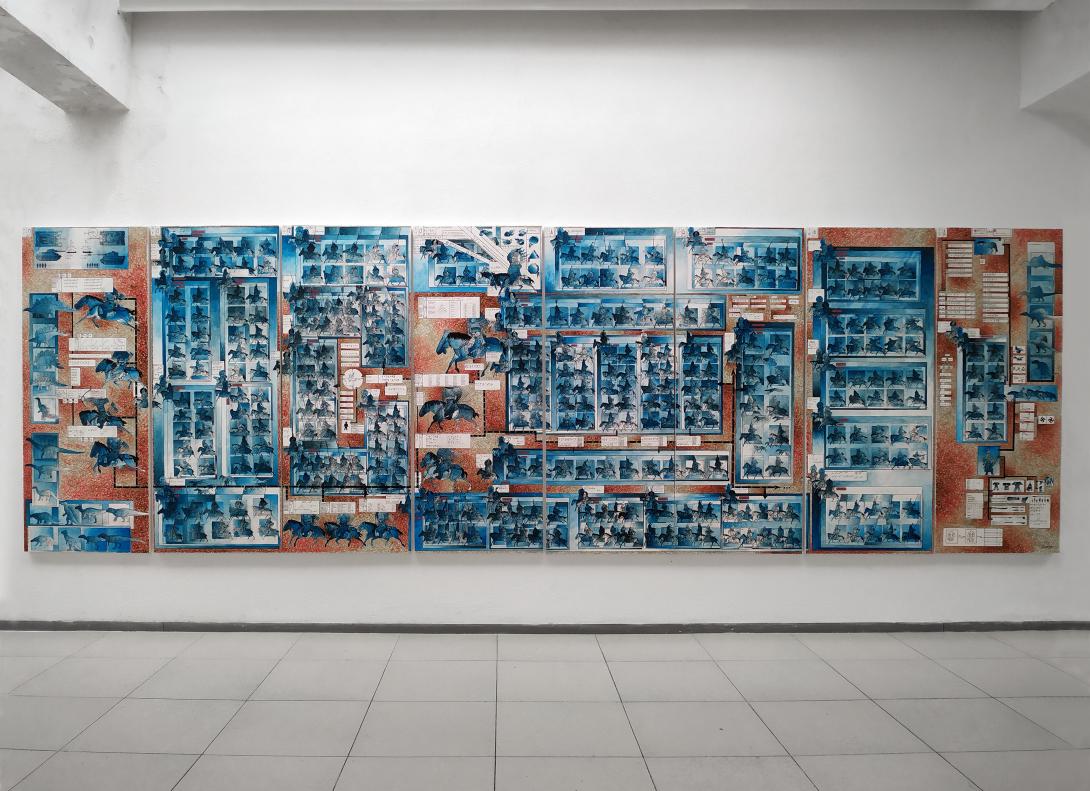
I selected Gerelkhuu Ganbold’s eight-part painting *Exoplanet* for the exhibition two years ago because it offers a pointed depiction of life in Mongolia today. At first glance, one sees individual "info boxes" containing groups of ten mounted Mongolian warriors, linked by lines resembling a flowchart. Interspersed among them are scientific and mathematical formulas, columns of binary code, and the numerical sequence: 10, 100, 1,000, 10,000.
These represent the units into which Chinggis Khaan organized his troops—thereby dismantling old clan structures, as he appointed men who could deliver results to lead these units rather than individuals holding hereditary power. Many of these leaders came from conquered territories, gaining influence and power through this system.
In other words, Genghis developed an inclusive, transparent, top-down model that fostered stability and secured international trade routes extending as far as Europe. The flowchart aesthetic fits this concept perfectly.
The painting must be viewed against the backdrop of Mongolia’s current political instability (three governments in nine months). I interpret the frequent use of Braille in the work in two ways: on one hand, as a critique of the "blindness" of Mongolia’s own government and society; on the other, as a reflection of the fact that—despite the vast number of figures depicted—none of the riders’ faces or eyes are visible. This echoes the tradition of Thangka painting, where an image is completed in every detail except for the eyes; only then do other monks join in to play music and chant sutras. Only when the painting is finally completed does the transformation occur—shifting from the mere depiction of a spiritual being to its potent manifestation through the image itself.
Gerelkhuu’s work does not reach this stage; he cannot bring about this metaphysical manifestation because reality itself does not allow for it. Yet that reality is present in the painting—manifested as the chaos of reddish-brown, swirling brushstrokes in the background, against which he positions his attempts at order in a bid to hold it at bay.
At this point, it struck me that the painting represents a contemporary attempt at a mandala. The blocks of information can be read like the cosmic quadrants at the center of a traditional mandala—elements that fail to find their proper place.
The painting is deeply rooted in Mongolia’s spirituality, artistic traditions, and history, while simultaneously offering an accurate portrayal of the country’s political and social upheavals. It is a masterpiece of museum quality.