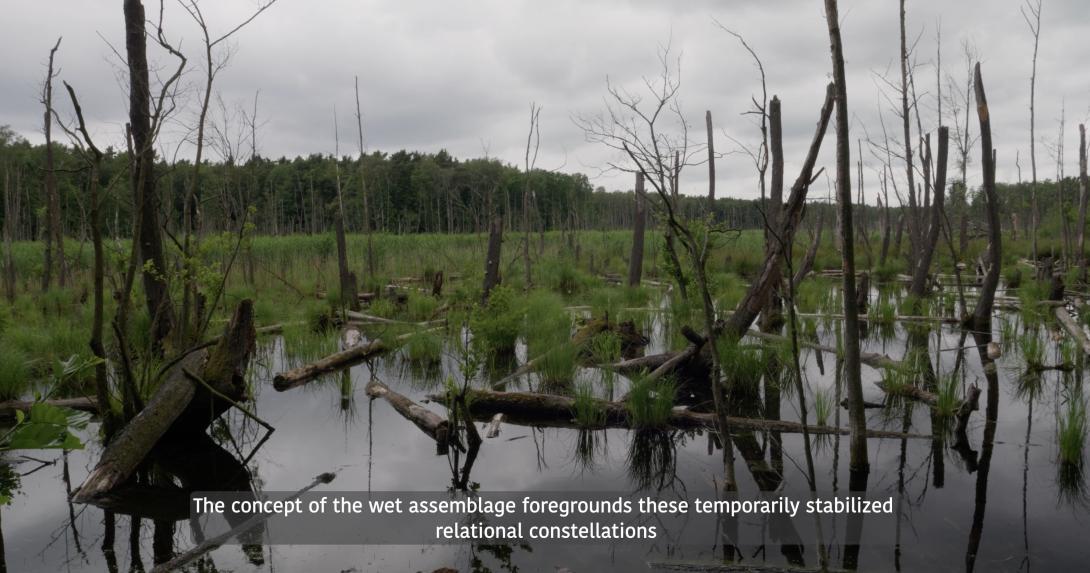
A wet assemblage emerges through the ongoing interactions of water, soils, organisms, and material processes. Drawing on Donna Haraway’s concept of sympoiesis and Stacy Alaimo’s notion of trans-corporeality, the film approaches wetlands as dynamic ecological and political fields in which human and more-than-human bodies, substances, infrastructures, and environments are continuously entangled. The human body is understood as an open and permeable system, engaged in ongoing material exchanges with water, microorganisms, and other bodies. This posthuman perspective extends Murray Bookchin’s social ecology by expanding its political field beyond human-centered subjects and reconsidering technology and ecological processes as mutually constitutive forces. Rather than rejecting social ecology, the film seeks to transform its emancipatory and communalist politics through the fluid, multispecies conditions of wetlands, bringing posthumanism into dialogue with green anarchism. Wetlands are not terra nullius, nor have humans ever existed outside ecological systems. Yet drainage, land reclamation, and engineered management can disrupt these relations and weaken wetlands’ self-regulating capacities. Against the logic of control, the film considers wetland politics as a practice of restraint—a form of “governing through calibrated non-action”: learning when to step back, slow processes, and refrain from acting.