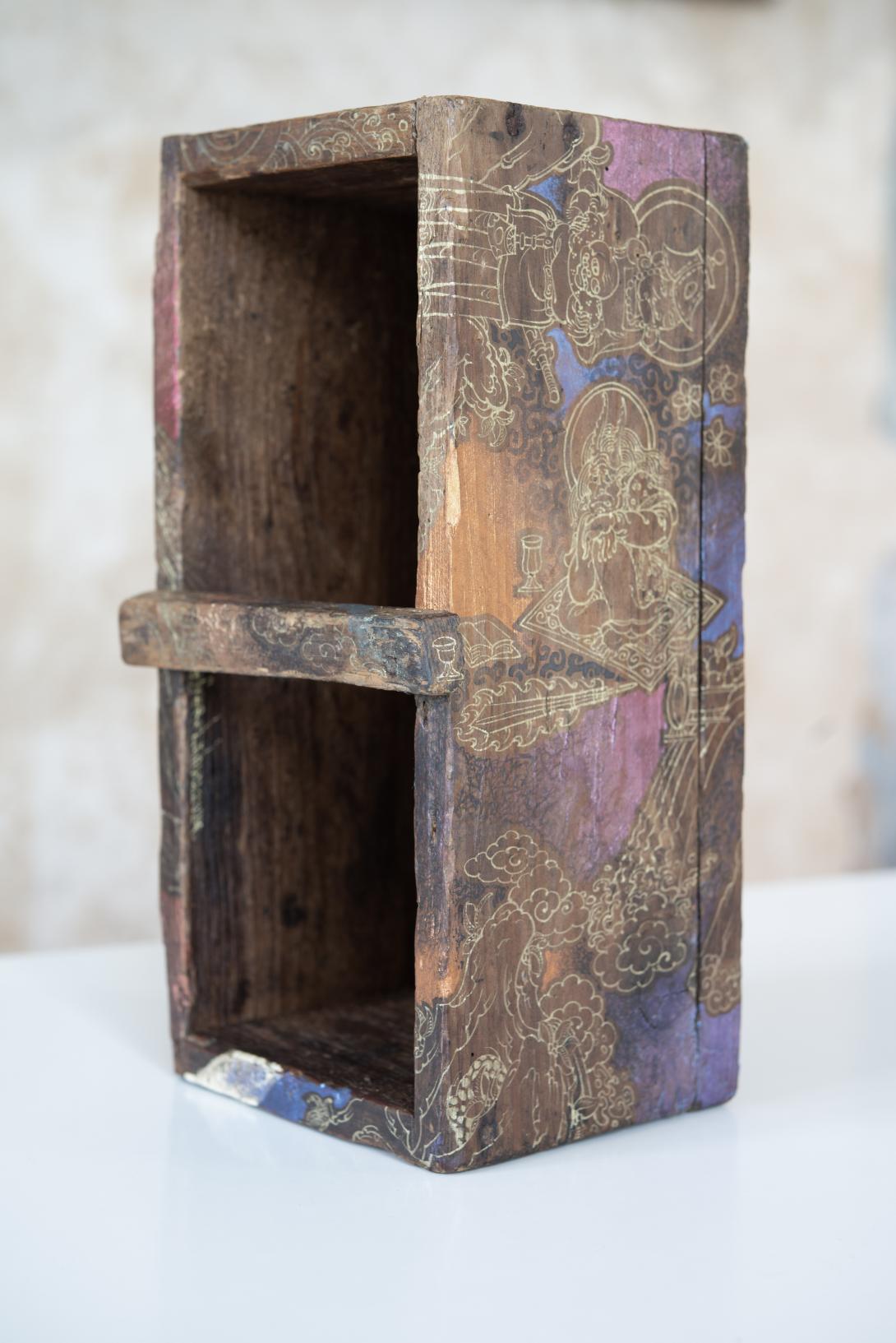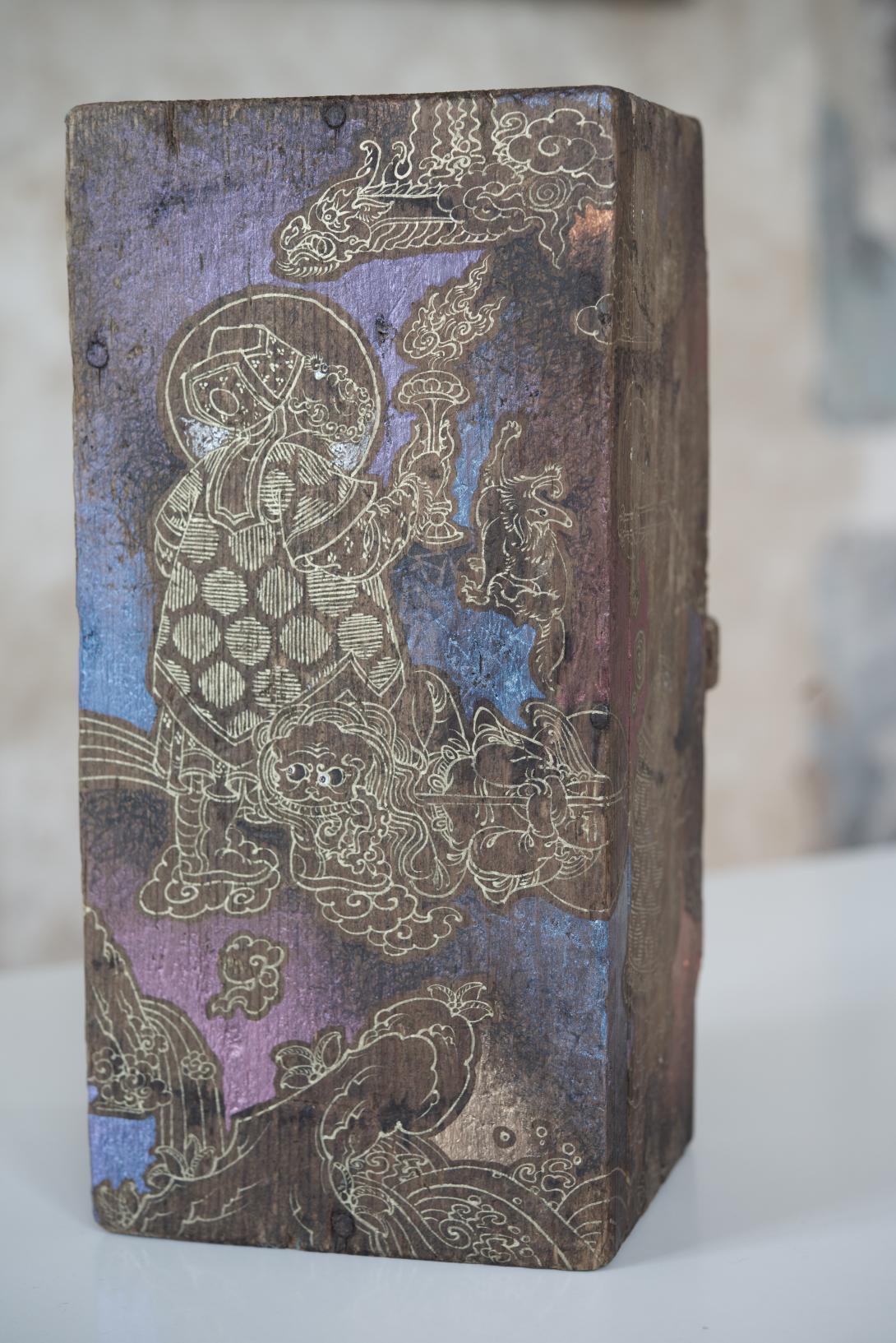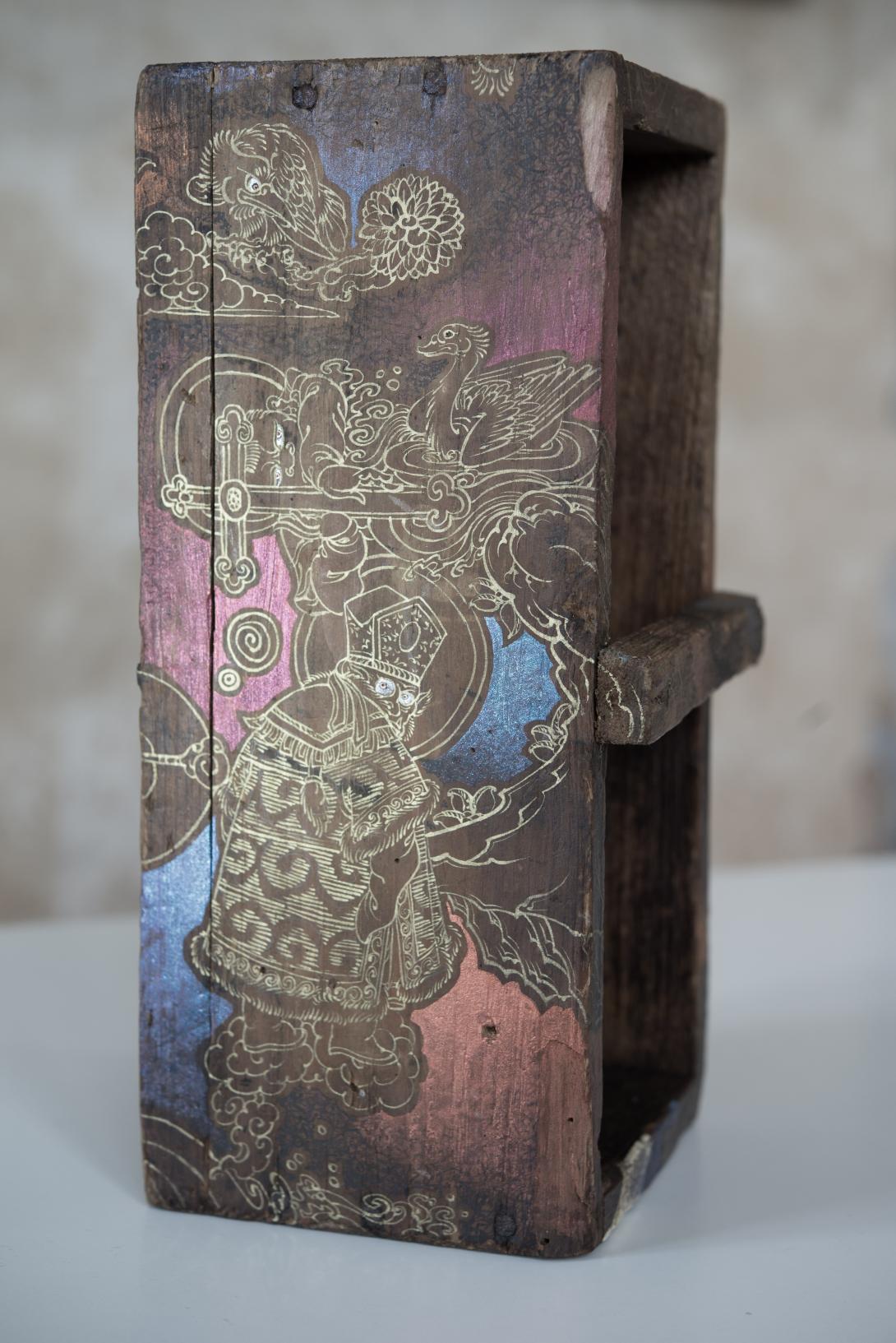
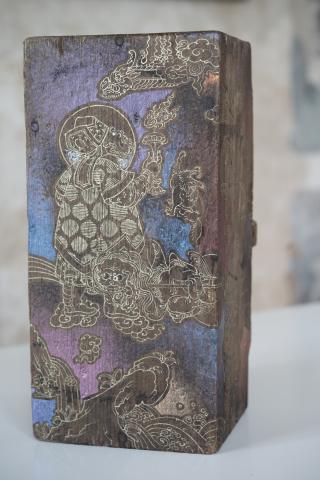
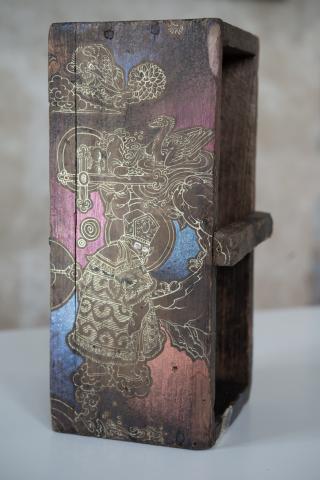
Gerelkhuu Ganbold, one of Mongolia’s most outstanding younger artists, has created a fascinating piece that blends the tradition of *Mongol Zurag* (traditional Mongolian painting) with Christian motifs. Inspired by a visit to the Diocesan Museum in Bamberg, the artist designed the work on a small wooden tool chest originating from the historic *Kunstmühle* (art mill) in Mürsbach. At the center stands a bishop, dressed in robes modeled after the famous imperial vestments held by the Diocesan Museum. He carries a torch and gazes upward toward a dragon-like creature emerging from the clouds—both elements rendered in the style of traditional Buddhist painting. By combining art-historical contexts of Christianity with the techniques of *Mongol Zurag*, the piece builds a unique bridge between cultures. It is currently on display as a contemporary intervention within the museum’s gallery of High Medieval imperial vestments—a collection unparalleled anywhere else in the world. This deliberate integration into the permanent exhibition is intended to challenge established ways of seeing and offer visitors fresh perspectives.
Cultural Background
The work reflects Mongolia’s long-standing tradition of religious tolerance, which dates back to the era of Genghis Khan in the 13th century. As early as 1255, when the Franciscan friar William of Rubruck arrived at the court of Möngke Khan in Karakorum, the capital was already home to communities of Nestorian Christians and Copts, as well as Jewish and Muslim groups. Mongol Zurag is a modern art movement established around 1920 by artists such as Balduugiin Sharav, emerging during a period when Mongolia was liberating itself from the dominance of the Chinese Manchu dynasty. Stylistically, Mongol Zurag draws upon motifs from Lamaist Buddhist thangka painting and elements derived from shamanic ritual objects. During the era of the communist Mongolian People's Republic, Mongol Zurag was banned; it was only revived in the 1990s by a younger generation of artists and has since experienced a renaissance.
Among the unique exhibits at the Diocesan Museum are the so-called "Imperial Vestments." These consist of six magnificent garments associated with Emperor Henry II (born 973, reigned 1002–1024) and his consort, Empress Kunigunde (c. 980–1033): the Star Mantle of Henry II, the Blue and White Mantles of Kunigunde, the "Rider’s Mantle," a tunic, and a rationale.
This exceptional collection of embroidered silk garments from the first quarter of the 11th century—together with the liturgical vestments of Pope Clement II (pre-1047), recovered from the only surviving papal tomb north of the Alps, and the "Gunther Cloth" (c. 975), one of the largest extant examples of Byzantine silk weaving—forms the cornerstone of a world-renowned textile collection.