
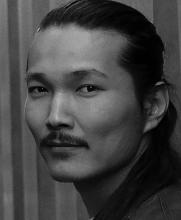
“I, Dorjderem, was born as the eldest son of Mr. Davaa, a powerlifter. Although I remember little from my early childhood, one vivid memory remains: when I was five or six years old, I gathered every piece of clay I could find and sculpted a large horse. It felt like my first act of self-expression. From that moment on, I sensed that I was destined to become a painter, sculptor, or artist.”
Dorjderem D. is a contemporary multidisciplinary artist who lives and works in Ulaanbaatar, Mongolia. Since 2005, his artistic practice has continuously explored themes of birth, death, and the human condition.
A pivotal source of inspiration emerged in 2001 when he encountered a collection of wild sheep horns at the National Museum of Mongolia. The materials had been left behind by a deceased naturalist and were about to be discarded. Dorjderem preserved them, and they later became an integral part of his first major work, Voice in the Space.
His practice is distinguished by the use of diverse materials and techniques, including goat skin, wild sheep and goat horns, wool, felt, acrylic, oil paint, and printmaking. He earned a Bachelor of Fine Arts degree from the School of Mongolian Arts and Culture and also trained as an artificer at R. Gandhi Polytechnic College of Production and Art.
Dorjderem’s work has been presented in major international exhibitions and biennials, including the 4th Fukuoka Asian Art Triennale (2009), Changwon Sculpture Biennale (2014), Continental Biennale (2025), and the Venice Biennale (2026).
His contributions to contemporary art have received both international and national recognition. Internationally, he received the People’s Choice Award at the APB Foundation Signature Art Prize, Singapore (2008), and his work was acquired by the Fukuoka Asian Art Museum, Japan (2009). In Mongolia, his works were acquired by the National Art Gallery of Mongolia in 2009 and 2024, and he received a grant from the Arts Council of Mongolia for his solo exhibition Non-Existence (2013).
“I, Dorjderem, was born as the eldest son of Mr. Davaa, a powerlifter. Although I remember little from my early childhood, one vivid memory remains: when I was five or six years old, I gathered every piece of clay I could find and sculpted a large horse.
Biography
“I, Dorjderem, was born as the eldest son of Mr. Davaa, a powerlifter. Although I remember little from my early childhood, one vivid memory remains: when I was five or six years old, I gathered every piece of clay I could find and sculpted a large horse. It felt like my first act of self-expression. From that moment on, I sensed that I was destined to become a painter, sculptor, or artist.”
Dorjderem D. is a contemporary multidisciplinary artist who lives and works in Ulaanbaatar, Mongolia. Since 2005, his artistic practice has continuously explored themes of birth, death, and the human condition.
A pivotal source of inspiration emerged in 2001 when he encountered a collection of wild sheep horns at the National Museum of Mongolia. The materials had been left behind by a deceased naturalist and were about to be discarded. Dorjderem preserved them, and they later became an integral part of his first major work, Voice in the Space.
His practice is distinguished by the use of diverse materials and techniques, including goat skin, wild sheep and goat horns, wool, felt, acrylic, oil paint, and printmaking. He earned a Bachelor of Fine Arts degree from the School of Mongolian Arts and Culture and also trained as an artificer at R. Gandhi Polytechnic College of Production and Art.
Dorjderem’s work has been presented in major international exhibitions and biennials, including the 4th Fukuoka Asian Art Triennale (2009), Changwon Sculpture Biennale (2014), Continental Biennale (2025), and the Venice Biennale (2026).
His contributions to contemporary art have received both international and national recognition. Internationally, he received the People’s Choice Award at the APB Foundation Signature Art Prize, Singapore (2008), and his work was acquired by the Fukuoka Asian Art Museum, Japan (2009). In Mongolia, his works were acquired by the National Art Gallery of Mongolia in 2009 and 2024, and he received a grant from the Arts Council of Mongolia for his solo exhibition Non-Existence (2013).